

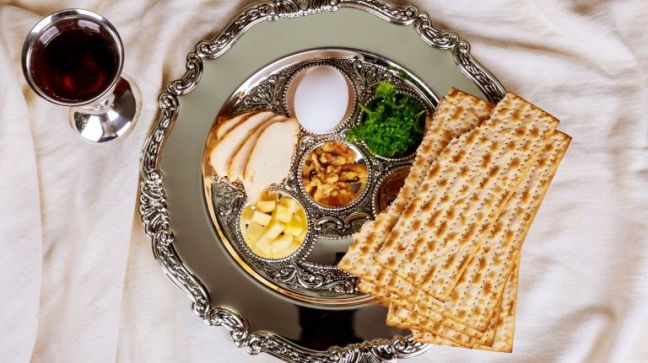
PESAH, or Passover is the oldest Jewish holiday, which celebrates the beginning of the Jewish people. Historically it was on Passover, over three thousand years ago, at midnight, under the first full moon of spring, that the Israelites escaped from Egyptian slavery. During the week long holiday, which falls in late March to mid April, Jews remember the power and importance of this event by eating special foods linked to the bitterness of slavery and the sweetness of freedom. The highlight of Passover is the Seder, a dramatic yet entertaining dinner rich with stories, food, and songs. Seder means “order” and a book called the “Haggadah” takes participants through the event celebration that retells the story of how the Jews became a free people. The ceremony begins by reliving slavery and ends by imagining what the world will be like when all people are free.
It is no coincidence that the events of the historic Passover and exodus from Egypt would parallel our spiritual Passover and exodus from the condemnation of sin. The beauty of a “Messianic Seder” is that the testimony of Christ as the Passover Lamb and the historic Passover illustrated together is the culmination of one complete prophetic story. The Seder is traditionally long, but because it is considered a “prophetic rehearsal” or “dramatization,” many creative styles have been utilized over the years making the Seder an exciting, unique expression for every family. The Seder begins by lighting candles followed by drinking four cups of wine. The four cups of wine used in the Seder symbolize four distinct promises made by God as told in Ex. 6:6-7. 1. Cup of Sanctification – “I will bring you out” 2. Cup of Deliverance – “I will deliver you.” 3. Cup of Redemption – “I will redeem you” 4. Cup of Restoration – “I will take you.”
What is also significant is that the Passover was the original meal Jesus took part in with his disciples before his crucifixion. This is the meal Christians today call the “Lord’s Super.” During this meal Jesus drank the first two cups in the traditional way. With the third cup, the Cup of Redemption, he said: “This is my blood” (Matt. 26:27-39). Jesus told his disciples that He would not drink the fourth cup (the Cup of Restoration), but promised to do so with them in the coming Kingdom (Matt. 26”29). Jesus changed the meaning and purpose of this age old tradition from this day forward. This is why he said, “In as often as you do this, do it NOW in remembrance of me.”

There are three pieces of matzah used during a Passover Seder. The matzah is the “Unleaven Bread.” Traditionally, the bread is slightly burned by the fire, with stripes from the grill and pierced with holes. This is why Jesus said, “This bread represents my body.” During the fourth part of the Seder the leader will break the middle of the three pieces of matzah in two. The smaller piece is returned to the Seder table and the larger piece is set aside “wrapped in a linen napkin” or bag. This larger piece is called the “Afikomen,” a word that comes from the Greek word for “dessert.” Afikomen is given this name not because it is sweet, but because it is the last item of food eaten at the Seder. Traditionally, after the Afikomen is broken, it is “hidden or buried” somewhere in the room. The Seder leader calls for the children to hide the Afikomen during the meal. The Seder cannot be concluded until the Afikomen is found and returned to the table so each guest can eat a piece of it. At this time the children at the table must search for it and “bring it back.” The children receive a reward (usually candy, money) when they bring Afikomen back to the table. The Seder leader pays a “ransom” or reward for the Afikomen so that the Seder can continue.
Over the thousands of years that the Passover Festival has been celebrated by Jewish people, it is clear they had no clue that Jesus’ life, death and resurrection would be woven throughout all of their customs. Now, there is no doubt that there traditions were actually “DIVINE INSPIRATIONS.”
As you can see, it is obvious the messianic Seder stories bear many shadows surrounding the passion of Christ. The stories allow each participant to recall very personally the captivity of sin and the redemption of salvation through Jesus Christ. The Passover pilgrimage retells our spiritual journey from darkness into light, from sin into salvation, from slavery into freedom. The Passover holiday and Seder is one of the most profound prophetic Jewish festivals that has now become relevant to ALL believers both Jew and Gentile. This is primarily because of the unique way the believer’s journey from sin to salvation is not only taught during this festival but also RELIVED both historically and spiritually.
The Passover festival and messianic Seder is truly something to experience and it will make the annual Easter season celebrations for Christians much more sacred, meaningful and spiritually RICH. If you’ve never attended one, it is most certainly time you did!
 Karen Gaithers-Life Discipleship